Predictive maintenance is more than condition monitoring
Condition monitoring tells you that something has changed. Predictive maintenance should help determine whether that change is deterioration, how it is developing and whether action is required.
A vibration value, temperature rise or change in current draw is not automatically a maintenance decision. The same reading can mean different things when the asset is under different load, production state, ambient condition or process demand.
This is why useful predictive maintenance requires context, not only sensors. The intelligence comes from connecting machine condition with the operating state that produced it.
How predictive maintenance solutions work
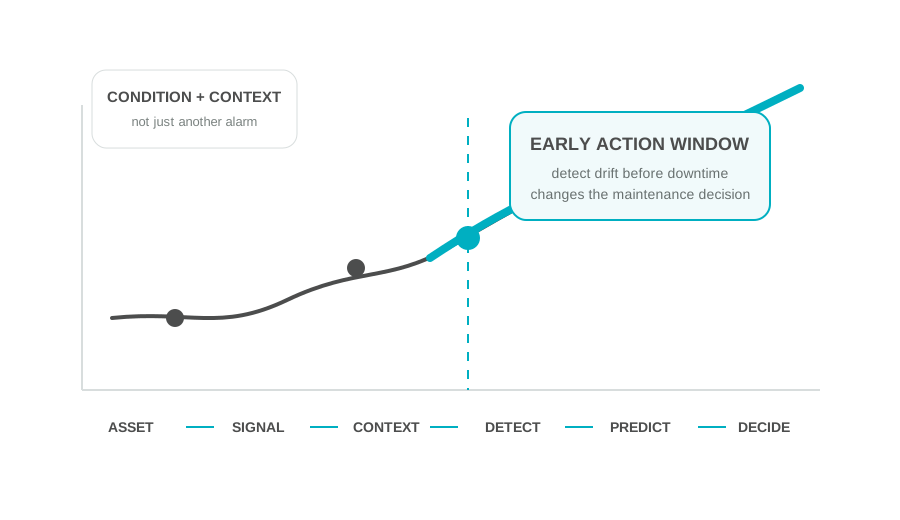
A practical predictive maintenance system should move through a simple decision chain: asset, signal, context, detect, predict, decide, maintain and learn.
The asset defines the equipment and failure mode. The signal captures what may reveal deterioration. Context explains whether the signal is abnormal for that operating state. Detection identifies deviation. Prediction estimates risk or intervention timing. The decision layer translates analytics into a maintenance action.
The final learning step is important. Confirmed technician findings, maintenance outcomes and repeated operating patterns should improve the intelligence layer over time.
Types of predictive maintenance solutions
Predictive maintenance is not one technology. Different assets and failure modes require different combinations of sensing, analytics and operational context.
- Vibration monitoring for motors, bearings, pumps, fans and gearboxes.
- Temperature and thermal monitoring for motors, electrical systems, bearings, furnaces and process equipment.
- Electrical condition monitoring using current, voltage, load and power-quality behaviour.
- Pressure and flow monitoring for pumps, compressors, utilities, hydraulic systems and process lines.
- Oil and lubrication analysis for gearboxes, turbines and heavy rotating equipment.
- Anomaly detection for multivariable assets where normal behaviour changes with operating conditions.
- Remaining Useful Life models where the plant has enough reliable history to estimate intervention windows.
- Digital Twin-based predictive maintenance where asset condition needs to be interpreted with process, load and operating context.
The right solution depends on the failure mode, not on which technology sounds most advanced.
What data does a predictive maintenance solution need?
A predictive maintenance project does not automatically require a new sensor on every asset. Many factories already generate useful data through PLCs, SCADA systems, drives, sensors, historians, EMS, MES, ERP, CMMS and maintenance records.
Existing signals may include motor current, bearing temperature, pressure, flow, speed, torque, vibration, runtime, start-stop frequency, production rate, alarms and operating state.
The stronger principle is simple: use the data that already exists, then add new sensing only where a decision-critical gap remains.
Predictive vs preventive vs condition-based maintenance
Reactive maintenance starts after failure. Preventive maintenance is triggered by time, runtime or a predefined schedule. Condition-based maintenance responds when measured condition crosses a threshold.
Predictive maintenance attempts to understand the trajectory of asset condition and whether deterioration is developing early enough to change the maintenance decision.
The goal is not to eliminate every preventive maintenance practice. Critical assets may still require scheduled inspections, OEM routines and safety checks. The value is in making maintenance decisions more informed where deterioration can be measured reliably.
Where AI and Digital Twin add value
AI can help detect patterns that are difficult to capture using static thresholds alone. Useful applications include multivariable anomaly detection, behavioural baselining, failure-pattern recognition, risk prioritization, degradation modelling and remaining useful life estimation.
Digital Twin extends this by connecting the condition of the physical asset with the operating environment around it. A motor temperature increase, for example, becomes more meaningful when interpreted with load, speed, ambient condition, production state and maintenance history.
The better question is not whether the solution uses AI. The better question is whether the intelligence creates enough warning, with enough context, to change what maintenance does next.
How to choose and start the right solution
Do not start by asking which platform has the most features. Start with the plant decision.
A strong predictive maintenance solution should be evaluated against asset coverage, relevant failure modes, existing data compatibility, context awareness, explainability, integration, intervention lead time, maintenance workflow, scalability and business-value measurement.
Begin with one costly or operationally important failure mode. Identify what data already exists, define what earlier warning should change, create a baseline and validate whether the prediction provides enough time for useful maintenance action. Scale only after the first use case proves value.
The Predictive Maintenance Intelligence Loop
A prediction has value only when it arrives early enough, with enough context, to change the maintenance decision. The loop is designed to move teams from isolated alarms toward actionable asset intelligence.
Predictive Maintenance & Asset Health
Know what is deteriorating before downtime becomes the signal.
Explore solution ↗Start without replacing systems
Use existing PLC, SCADA, sensor, drive and maintenance data first.
Read related insight ↗What to carry into the plant.
- Start with a failure mode and maintenance decision, not a technology purchase.
- Reuse existing machine and operational data before adding more sensors.
- Interpret condition signals with load, process and operating context.
- Use AI only where it improves detection, prioritization or intervention timing.
- Validate whether the warning arrives early enough to change maintenance action.
Direct answers.
What are predictive maintenance solutions?+
Predictive maintenance solutions use equipment-condition data, operating context and analytics to detect deterioration and estimate when maintenance intervention may be required before unexpected failure occurs.
What is the difference between predictive and preventive maintenance?+
Preventive maintenance is generally triggered by time, runtime or a predefined schedule. Predictive maintenance uses measured asset condition and deterioration patterns to determine when maintenance attention is likely to be needed.
What technologies are used in predictive maintenance?+
Common technologies include condition sensors, PLC and SCADA data, vibration monitoring, temperature monitoring, electrical analysis, IoT connectivity, historians, anomaly detection, machine learning, asset-health analytics, CMMS integration and Digital Twin technology.
Can predictive maintenance work with existing machines?+
Yes. Predictive maintenance can often begin with condition and operating data already available from PLCs, SCADA systems, drives, sensors, historians and maintenance systems. Additional sensors should be added where important condition data is missing.
How does Digital Twin support predictive maintenance?+
A Digital Twin can connect asset-condition signals with operating context, process state and models so equipment behavior can be understood under different operating conditions and used to support earlier maintenance decisions.
This insight is based on Digi I4.0's DigiTwin architecture, predictive maintenance solution positioning, DigiGateway connectivity thinking and existing industrial intelligence framework. Use the linked pages for the underlying implementation context.